


China Medical Travel Guide
Medical Travel from the United States to China– Complete Guide and a Practical Method to Assess Whether It’s Right for You
This article is part of our Global Medical Travel to China hub, which provides structured guidance for patients from 50+ countries worldwide.
👉 Go to full hub: Medical Travel to China

If you are currently being treated within the US healthcare system, or you are thinking about different treatment options, you may have already noticed a very real issue — the medical care itself is highly professional, but the pace doesn’t always match everyone’s situation.
Most people start reconsidering their options while they are still waiting — whether it’s long appointment delays, extended diagnostic timelines, or unclear treatment pathways.
It is in this context that “medical travel from the United States to China” has started to become something more patients are seriously looking into.
But the real question is not simply whether it’s possible — it’s whether you are actually a good fit for it.
We try to make this decision easier with a quick and simple evaluation process, especially for patients covered under ACA marketplace insurance in the United States, which may help identify options that can significantly reduce medical costs by at least 50%.

Table of Contents
- Why more and more patients are considering medical travel from the United States to China?
- Why China has become a key destination for medical travel?
- The most common treatment types for US patients in China
- How to determine whether you are suitable for medical travel from the US to China (core steps)?
- Support and services we provide for international patients
1.Why More International Patients Are Starting to Pay Attention to China’s Cyberpunk Mountain City?
Looking at the information and discussions we have seen on social media over the years, one trend has become very clear: most people do not start out planning to seek medical care overseas. The idea usually comes later, after they experience delays, high costs, or uncertainty during their treatment journey.
There are usually three main reasons that push people to start considering other options.
The first is time.
In the United States, many patients wait a very long time from the first specialist appointment to the completion of their full treatment process.
Based on our observations among people with ACA health insurance, a typical timeline looks like this:
For common chronic conditions managed with conservative treatment, the full process often takes around 3–5 months.
For conditions that require imaging, multiple specialist visits, and follow-up evaluations, the timeline can extend to around 4–6 months.
For orthopedic and surgical procedures, many patients face waiting periods of six months or longer, while more complex surgeries can take 7–9 months or even more.
Even standard cancer treatment pathways often take more than six months once referrals, insurance approvals, scheduling, and access to medical equipment are included. Every step can add more time before treatment actually begins.
The second is cost.
Under the US ACA health insurance system, even when a treatment is covered by insurance, patients may still face significant out-of-pocket expenses, including deductibles, copayments, and specialist costs.
For many middle-income families, lower-tier ACA plans can come with high deductibles and substantial personal expenses before insurance coverage fully applies.
For serious conditions or surgical treatments, the total out-of-pocket cost throughout the entire treatment process can become a major financial burden.
Take cataract surgery as an example.
Many Silver and Bronze ACA plans come with high deductibles. Before meeting the deductible, patients may need to pay a large portion of the diagnostic process themselves.
When surgery copayments and additional costs for premium intraocular lenses are added, the total personal expense for treatment of both eyes can reach several thousand dollars or even over ten thousand dollars.
The third is uncertainty.
During treatment, many patients start looking for a second medical opinion because they want to know whether their current treatment plan is the only option or the best option available.
When these factors come together — long waiting times, rising personal costs, and uncertainty about treatment choices — more people begin seriously looking into whether medical travel from the United States to China could be an option for them.
More importantly, many patients simply do not want their healthcare decisions to be controlled entirely by insurance limitations and costs.
That is why some people quietly begin researching alternative paths and making their own plans for a different healthcare option.
2.Why China has become a key destination for medical travel?
From the perspective of the healthcare system, China has several clear advantages.
First, medical resources are highly concentrated. Large tertiary hospitals, especially those with strong specialist departments, have accumulated extensive clinical experience across many areas of treatment.
Second, the overall process is often more efficient. From medical examinations and specialist consultations to treatment arrangements, the timeline is usually more streamlined, with faster coordination between different steps.
Third, there is a significant difference in healthcare costs. For many common treatment pathways, the overall cost in China is often much lower than in the US healthcare system, although the actual cost depends on the specific condition, treatment plan, and hospital level.
Finally, services for international patients have continued to improve. This includes language support, medical record coordination, and assistance with cross-border healthcare arrangements, making the entire process more organized and easier for overseas patients to follow.
3.The most common treatment types for US patients in China
Based on the international patient cases we have come across, the treatment needs can generally be grouped into several categories.
Orthopedic conditions are one of the most common areas, including issues such as knee injuries and spinal problems. These cases often involve restoring physical function or considering surgical treatment.
Patients dealing with cancer-related conditions are usually more focused on getting a second medical opinion, hoping to further confirm whether their current treatment plan is the right choice.
Eye care is another common area, such as cataract surgery and vision correction procedures. These treatments usually follow more established and standardized pathways.
Rehabilitation treatment is mainly focused on long-term recovery, including areas such as neurological rehabilitation and recovery after a stroke.
There is also another group of patients with more complex situations. They may have already completed multiple rounds of testing but still do not have a clear diagnosis. In these cases, what they often need is a complete review and restructuring of their overall medical pathway.
4.How to determine whether you are suitable for medical travel from the US to China (core steps)
The biggest problem many people face at this stage is not a lack of information, but uncertainty about whether their situation is worth considering cross-border medical care.
The first step is to confirm whether you currently have health insurance and what type of insurance plan you have.
To clearly compare the cost differences between having insurance, not having insurance, and different insurance plans, you can use the table below to estimate your potential medical expenses. This can help you understand the possible costs in advance and decide whether the treatment plan is worth pursuing.
| Treatment Item | Estimated Full Process Duration | Full Cost Without Insurance | Out-of-Pocket Cost: ACA Bronze/Silver (Mid-Low Tier) | Out-of-Pocket Cost: ACA Gold/Platinum (High Tier) | Service Coverage Details | Budget Assessment Recommendation |
|---|---|---|---|---|---|---|
| Bilateral Cataract Surgery | Around 6 months | $9500~13000 | $6000~9000 | $1800~3200 | Preoperative examination, surgery, basic intraocular lens, 3 post-op follow-ups; premium lenses at additional cost | Huge difference in out-of-pocket expenses. Overseas medical care is recommended to cut overall costs based on personal budget |
| Orthopedic Joint Replacement Surgery | 7~9 months | $38000~52000 | $8500~10600 | $2500~4500 | Specialist consultation, full imaging scans, pre-op physical exam, surgery, hospitalization, post-op rehabilitation follow-up | Out-of-pocket cost for mid-low tier ACA plans nearly hits annual maximum limit. Calculate alternative treatment options in advance |
| Standardized Oncology Treatment | 6~8 months | $45000~80000 | $9000~10600 | $3000~5000 | Biopsy, staging imaging, multi-cycle chemo/radiotherapy, long-term specialist follow-up, prescription medication | High annual out-of-pocket cap for severe illness; long-term treatment creates heavy financial burden for families |
| General Chronic Disease Specialist Program | 3~5 months | $4000~7000 | $2200~4000 | $600~1500 | Multiple specialist visits, blood work/MRI/CT scans, long-term oral medication, quarterly follow-up checks | Cost gap is moderate for mild conditions. Choose local or cross-border treatment based on personal income |
This guide only applies to people covered by ACA marketplace insurance plans: If you have low-tier Bronze/Silver ACA coverage, elective surgery and remote second medical opinions are best done in China to cut huge out-of-pocket costs and skip long US wait times. Comprehensive full-body health screenings are ideal for two groups: budget-focused young Bronze plan holders, and middle-class Americans wanting more thorough screenings than US local providers offer. For anyone with premium Gold/Platinum ACA plans, minor routine illnesses are better treated locally in the US. You only gain value traveling to China for specialized advanced full-body checkups.
Step 2 Click here to upload your medical needs and verify a realistic cost range.
You only need to provide basic information, not organize a complete medical record, including:
Your current diagnosis or main symptoms, medical tests you have already completed (such as CT, MRI, laboratory tests, etc.), the treatment recommendations given by your current doctor, and your main goals and concerns (such as cost, time, or treatment option choices).
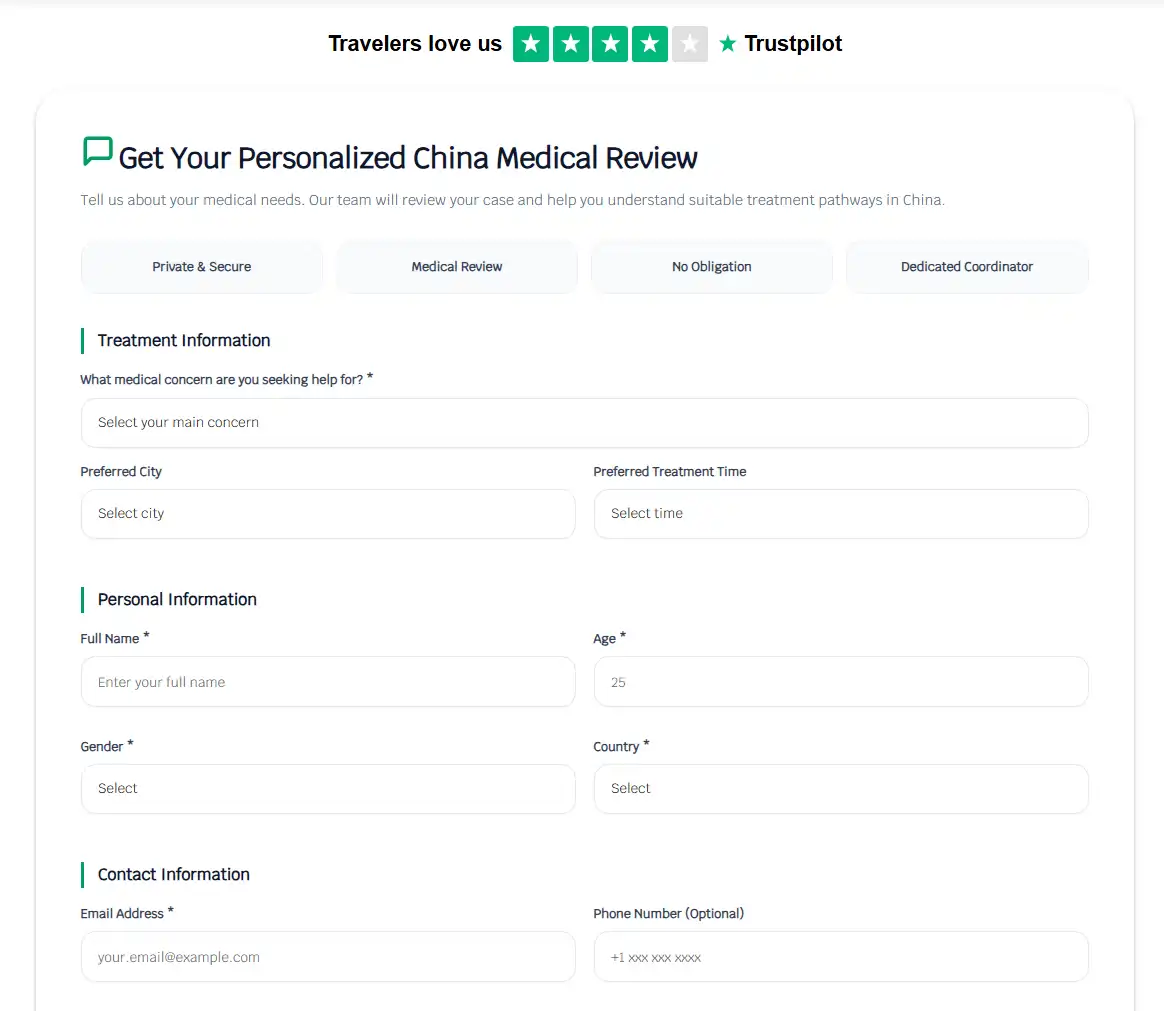
After submitting this information, it will enter an initial assessment process, which mainly evaluates three points:
Whether you are suitable to consider medical travel from the US to China, the possible treatment pathway, and the estimated cost range (for reference only, not an exact quotation).
In some cases, the result may suggest further evaluation. In other cases, it may clearly indicate that cross-border medical treatment is not recommended.
The purpose of this step is to reduce uncertainty first, rather than directly push you to make a decision.
5.Support and services we provide for international patients
In the entire process, our role is closer to medical information coordination and treatment pathway analysis, rather than making medical decisions for patients. Although our medical coordinators all have more than 5 years of clinical experience.
We provide:
- Initial case analysis and medical information organization
- Matching suitable hospitals and specialist departments
- Providing initial suggestions on possible treatment pathways
Our core goal is to help patients clearly answer one question:
Is it worth moving forward to the next stage of medical travel from the US to China?
For most people, the hardest part is not making a choice, but constantly hesitating when they do not have enough information.
Once the basic medical information is organized clearly, the question of whether to consider cross-border medical care often becomes much easier to answer.
If you are currently at this stage, the most important thing may not be making a decision right away, but first getting a clearer understanding of your situation.
This article is part of our Global Medical Travel to China hub, which provides structured guidance for patients from 50+ countries worldwide.
👉 Go to full hub: Medical Travel to China
6.Frequently Asked Questions (FAQ)
1. Is medical travel from the US to China safe?
Yes. Many large hospitals in China that accept international patients operate under standardized medical procedures and have experience treating overseas patients. These hospitals also provide interpreter support and coordinated care processes for foreign patients.
2.How much can I save with medical travel from the US to China?
In many cases, patients may reduce overall medical expenses by around 50%–80%, depending on the condition, hospital, and treatment plan. The final cost varies based on diagnosis, procedure type, and medical requirements.
3.Do I need health insurance to receive treatment in China?
No. Patients can receive treatment in China with or without US health insurance. However, having ACA or private insurance may affect your overall financial planning before deciding to travel.
4.What types of treatments do US patients usually seek in China?
Common cases include orthopedic treatments (knee, spine), cancer second opinions, eye surgeries such as cataract procedures, rehabilitation therapy, and complex diagnostic evaluations.
5.How do I know if I am suitable for medical travel from the US to China?
Suitability depends on your medical condition, current treatment progress, cost expectations, and timing needs. A basic case review including your diagnosis, test results, and doctor recommendations is usually used for initial evaluation.
6.What information do I need to provide for an initial medical review?
You typically only need to share basic information such as your diagnosis, existing medical reports (CT, MRI, lab tests), current treatment plan, and your main concerns like cost, time, or treatment options.
7.Will I receive a final medical diagnosis during the initial evaluation?
No. The initial review is not a final diagnosis. It is a preliminary assessment to understand whether cross-border treatment may be suitable and what possible treatment direction could be considered.
8.How long does the evaluation process take?
In most cases, initial feedback can be provided within a short timeframe after receiving the required medical information. The goal is to reduce uncertainty before making any treatment decisions.
9.Can I still stay in the US for treatment after the evaluation?
Yes. The evaluation is for informational purposes only. Patients can choose to continue treatment in the US or explore other options based on the results.
10.What is the role of your medical coordination team?
The coordination team focuses on organizing medical information, reviewing cases, matching appropriate hospitals and specialists, and outlining possible treatment pathways. Final medical decisions are always made by licensed physicians and the patient.

 Treatments
 Non-invasive
 Pain Management
 Health Check
 Traditional Chinese Medicine
 Dentistry
 Ophthalmology
 Book Free Consultation